Babbitty Rabbitty’s demonstration
The Tales of Beedle the BardBabbitty Rabbitty’s demonstration is the public unmasking of a would-be wizard King and his accomplice, the charlatan. Babbitty secretly performs the King’s supposed feats until his attempt to revive a dead hound fails; that failure exposes the limits of magic, brings the fraud to light, and gives Babbitty leverage to end the kingdom’s persecution of witches and wizards. The episode turns a staged display of royal authority into an encounter with what magic cannot do—and with the obligations a ruler has tried to evade.
The public performance
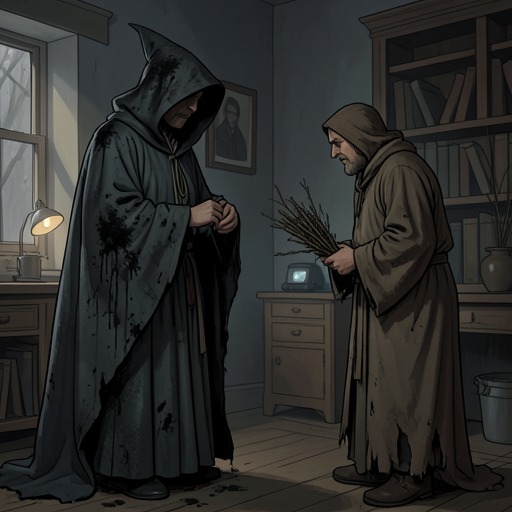
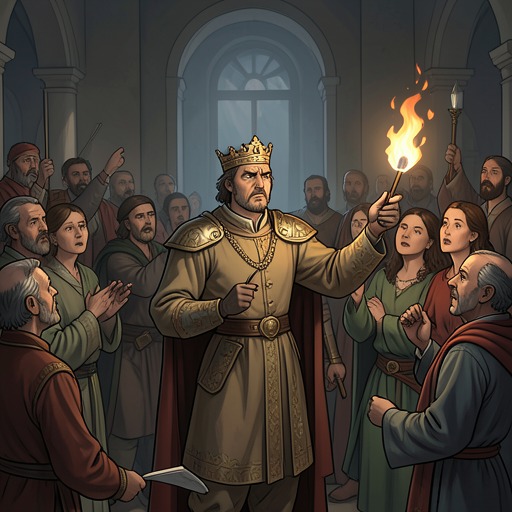
The following morning, the kingdom’s lords and ladies gather in the palace grounds. The King climbs onto a stage beside the charlatan, intending to display the magic he believes he has learned by waving a twig. Babbitty, concealed in a nearby bush, supplies the actual magic, making the King appear to command powers he does not possess.
The King first points his twig at a noblewoman and announces that he will make her hat disappear. From the bush, Babbitty uses her wand to vanish it. The crowd responds with astonishment and applause, and the King is jubilant. He follows with a promise to make his own horse fly; Babbitty again performs the magic in secret, raising the horse high into the air. The more spectacular second feat earns an even more enthusiastic response, strengthening the King’s public image while concealing the arrangement that makes the display possible.
The performance depends on the King’s audience mistaking results for proof of his ability. Babbitty’s hidden work makes the deception look convincing, but it also leaves the King dependent on her whenever he announces a new feat. When he looks around for another idea, the Captain of the Brigade of Witch-Hunters supplies one that turns the entertainment into a test with irreversible stakes.
The limit that breaks the deception
The Captain tells the King that Sabre, the largest of the witch-hunting hounds, has died after eating a poisonous toadstool. He hauls the dog’s lifeless body onto the stage and challenges the King to bring it back to life. The King points his twig at Sabre, but Babbitty does not lift her wand: no magic can raise the dead.
The failure changes the crowd’s response. At first people whisper; then they laugh, suspecting that the King’s two earlier feats were tricks. The charlatan, confronted with the collapse of the performance, points to Babbitty’s hiding place and accuses her of being a witch who is blocking the King’s magic. His accusation attempts to transfer suspicion away from the fraud and onto the person who made the apparent wonders possible.
The episode’s decisive reversal rests on a boundary rather than a stronger spell. Babbitty can produce the vanishing hat and flying horse, but she will not pretend that death can be undone. The King’s failure reveals both the falsity of his claim and a genuine limit on magic; an audience that had applauded his apparent power now sees that he cannot fulfil the command at the heart of the public challenge.
Exposure, escape, and confession
The Brigade of Witch-Hunters pursues Babbitty, releasing its hounds as she flees. At a low hedge, she vanishes from sight. When the King, charlatan, and courtiers follow, they find the dogs around a bent, aged tree. The charlatan insists that Babbitty has transformed herself into it and urges the King to cut it down before she can return to human form and denounce him. The King acts on that instruction, and the courtiers and charlatan cheer as the tree is felled.
As the party prepares to return to the palace, loud cackling stops them. Babbitty’s voice comes from the remaining stump, which points out that a witch or wizard cannot be killed merely by being cut in half. It challenges the King to test the claim on the charlatan, whom the stump calls the Grand Sorcerer. The Captain is ready to carry out the experiment, but the charlatan falls to his knees, begs for mercy, and confesses his wrongdoing. He is dragged away to the dungeons while the stump continues to cackle.
The exposure thus arrives through the charlatan’s own response to a threatened test. His earlier deception relied on the King’s confidence and the crowd’s willingness to credit appearances; faced with the possibility of suffering the same treatment he encouraged against Babbitty, he abandons the pretence and confesses. The failed revival first undermines the King’s display, while the stump’s challenge makes the fraud’s author answer for it.
A royal decree and lasting memorial
Babbitty then addresses the King, telling him that cutting down a witch has unleashed a curse: henceforth, every harm he inflicts on witches and wizards will feel like an axe stroke in his own side, until he wishes he could die. The petrified King drops to his knees and promises to issue a proclamation protecting every witch and wizard in the kingdom and allowing them to practise magic in peace. The threat converts the King’s power to persecute into a personal liability, and his promise marks the political consequence of the public exposure.
Babbitty does not let the proclamation stand as the only reparation. When the King offers to do anything, she requires a statue of Babbitty to be erected on the stump in memory of the washerwoman and as a permanent reminder of the King’s foolishness. He agrees to commission the foremost sculptor in the land and have the statue made of pure gold. The court returns to the palace, leaving the stump behind; when the grounds are empty, a stout, whiskery old rabbit wriggles from a hole among its roots, holding a wand between her teeth, and hops away. The rabbit is Babbitty, whose escape confirms that the attempt to destroy her has failed.
The statue and the proclamation preserve two distinct outcomes of the demonstration. The decree changes the kingdom’s treatment of witches and wizards: thereafter, none is persecuted there. The gold image fixes the King’s humiliation in a public memorial, linking protection to an enduring reminder of the ruler’s own folly. Babbitty leaves, but the consequences of her intervention remain in the grounds and in the law she has compelled the King to promise.
Magical law and political meaning
The commentary on the tale identifies the dead hound as the episode’s clearest lesson in magical limits: magic cannot reunite body and soul once death has occurred. Babbitty’s refusal to attempt a revival is therefore not an inability concealed by the plot, but the point that brings the King’s false claim into view. The story’s rule places a limit on what the King can achieve even while he imagines that learning incantations and waving a wand will make him a wizard.
The commentary also describes Babbitty as an early literary example of an Animagus, a witch who can transform into an animal at will, and notes that such transformations require study and practice. The account qualifies the tale’s treatment of her powers: Animagi do not retain human speech in animal form, although they keep their human reasoning. Babbitty’s rabbit form at the end thus supplies her escape, while the talking stump belongs to the story’s particular dramatic device rather than an ordinary account of transformation.
The episode’s political reversal is as important as its magical one. The King begins with a public show meant to establish his command of magic; when the show fails, the institutions he has directed against witches—the Captain and the Brigade—pursue the person who can expose the deception. Babbitty turns that pursuit back upon the King and obtains a public guarantee of protection. The story makes the boundary of magical power the instrument of political accountability: the King cannot command life to return, but he can be made to answer for the harm his rule permits.
The result also fits the wider account of Beedle’s tales, in which magical characters face problems that magic does not simply solve. Babbitty does not defeat the King by claiming a power greater than his imagined one. She relies on concealed assistance, the distinction between an illusion of command and actual magical ability, and the limits made visible by Sabre’s death. Her demonstration ends not with the King mastering magic, but with the kingdom required to let its witches and wizards practise theirs in peace.